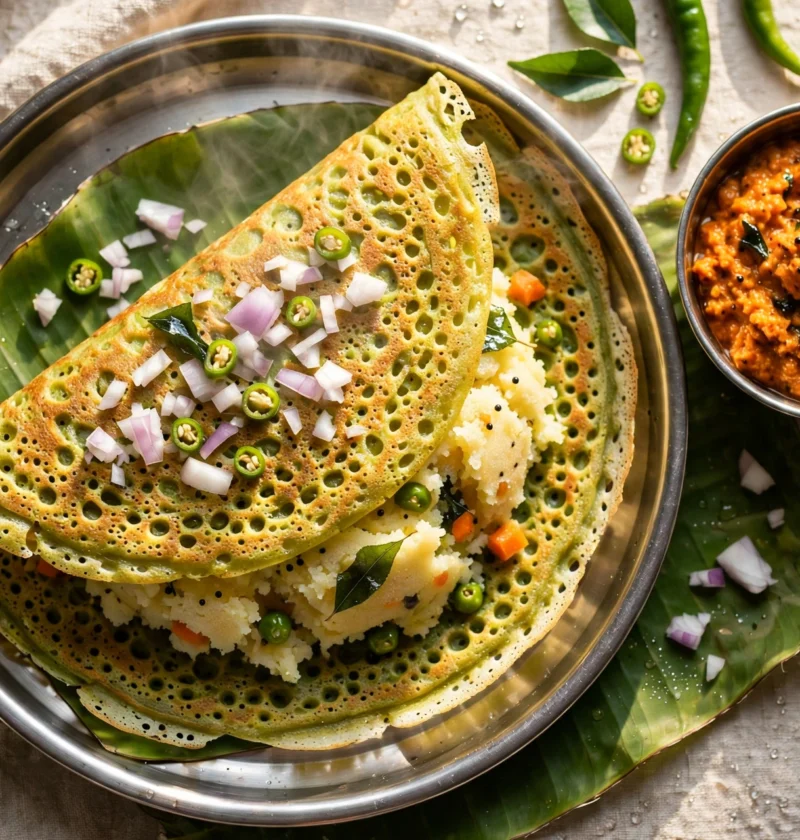
The tiffin room in Vijayawada had twelve tables, a ceiling fan that ticked on every turn, and a waiter who never wrote anything down. My uncle ordered for the whole table without looking at the board: pesarattu upma, extra onion, ginger chutney on the side, coffee after. He said it the way other men state facts about the weather — beyond argument. This is the only real breakfast, he announced, and anyone who eats idli in Vijayawada is simply passing through. I was young enough to believe him completely, and the first crisp, green-gold crepe that landed in front of me did nothing to argue back. This pesarattu recipe is my attempt to keep his certainty alive, far from that tiffin room.
What stayed with me was not only the taste but the logic of it. There was no batter waiting from yesterday, no fermentation to plan around. The moong had gone into water the night before, and by morning it was ground fresh with ginger and chillies and spread straight onto the tawa. The whole thing tasted alive in a way fermented batters do not — green, peppery, faintly sweet from the onion that softened against the hot crepe. Years of making pesarattu at home taught me that the dish forgives almost everything except one mistake: leaving the batter around until it turns sour. Fresh is not a preference here. Fresh is the recipe itself, and every honest pesarattu recipe I have met since has started from exactly that rule.
Why This Pesarattu Recipe Works
Pesarattu has fewer moving parts than almost any dosa — no ferment, no rice-heavy batter — but each part matters more for exactly that reason. This pesarattu recipe is built on five habits that the tiffin rooms never skip:
- Whole green moong is soaked, never split dal from a packet shortcut. The whole bean, soaked until plump, grinds into a batter with body and that unmistakable green colour. Split moong makes a pale, thinner crepe that tears on the tawa and tastes like a compromise.
- A small handful of raw rice goes in with the moong. Moong alone crisps reluctantly. Two tablespoons of rice, soaked alongside, give the edges the shattering quality you want — the centre stays supple while the rim turns lacy and brittle.
- The batter is ground slightly grainy, never silky smooth. A batter ground to paste spreads thick and steams. One ground to a fine semolina texture pours, spreads thin, and sets into a crepe with a delicate chew under the crispness.
- Nothing ferments, and the batter rests only fifteen minutes. That short pause simply lets the ground moong settle and hydrate. Beyond it, the clock is the enemy — an old batter sours, and sourness is the one flavour this dish cannot carry.
- The onion goes on raw, while the top is still wet. Pressed gently into the unset surface, the chopped onion and chilli half-cook in the steam rising off the crepe. They stay sweet and sharp at once, instead of frying into the background the way a cooked topping does. In this pesarattu recipe that raw, just-softened crunch is half the pleasure of eating.
Ingredients
The pesarattu is Andhra Pradesh’s answer to the dosa, and it begins with the humble mung bean — the small green legume that has fed half of Asia for centuries in one form or another. In coastal Andhra homes the crepe is rarely served bare: a spoonful of soft upma is tucked inside for the famous pesarattu upma, and a fiery ginger chutney called allam pachadi rides alongside, because moong’s gentle, grassy flavour loves heat and bite. Use whole green moong with the skins on — that is where the colour, and most of the goodness, lives. The batter should pour like a dosa batter but feel faintly sandy between your fingers; if it runs like water, the crepes will tear, and if it plops like pancake mix, they will never crisp.
Serves 4
For the batter:
- 1 1/2 cups whole green moong beans, picked over and rinsed
- 2 tablespoons raw white rice
- 1-inch piece fresh ginger, roughly chopped
- 3 to 4 fresh green chillies, roughly chopped
- 1 teaspoon cumin seeds
- 1 teaspoon salt, or to taste
- About 3/4 cup water, for grinding, added gradually
For the topping and serving:
- 1 large onion, finely chopped
- 2 fresh green chillies, finely chopped
- 2 tablespoons fresh coriander leaves, finely chopped
- Oil, for drizzling around each crepe (about 1 teaspoon per pesarattu)
- Ginger chutney (allam pachadi), to serve
- Soft upma, warmed, if you want the full pesarattu upma treatment (optional)
How to Make This Pesarattu Recipe – Step by Step
Step 1: Soak the moong and rice until the beans swell. Tip the rinsed moong and rice into a large bowl and cover with plenty of cold water — the beans will drink more than you expect. Leave them for at least 6 hours, or overnight on the counter. By morning the moong should have swelled to nearly double, and a bean pressed between your fingernails should split without a fight. Drain off the soaking water completely; it carries the raw, beany smell you do not want in the batter.
Step 2: Grind fresh, and stop while the batter is still faintly grainy. Put the drained moong and rice into a blender with the ginger, green chillies, cumin and salt, and add the fresh water a little at a time. Grind in bursts, scraping down the sides, until you have a pourable batter the texture of fine sand suspended in cream. Rub a drop between your fingers: smooth, and the grinding went too far; gritty like semolina, and you are exactly right. Tip the batter into a bowl, stir it well, and let it stand for 15 minutes — no longer ambitions than that. This pesarattu recipe begins now, not hours from now.
Step 3: Heat the tawa properly and learn the sprinkle test. Set a cast-iron tawa or heavy flat pan over medium-high heat and let it get thoroughly hot — a full two minutes, not a hopeful thirty seconds. Flick a few drops of water across the surface with wet fingers: they should hiss, skitter and vanish almost at once. Too cool, and the batter will stick and set into a thick pancake; smoking furiously, and it will seize before you can spread it. Wipe the tawa with a halved onion speared on a fork, or a barely oiled paper towel, so the surface is clean but not greasy.
Step 4: Spread thin, scatter the topping, and let the oil do its work. Spoon roughly a third of a cup of batter onto the middle of the hot tawa and, working quickly with the back of the ladle in widening spirals, spread it outward into a thin, even circle. Before the surface dries, shower it with chopped onion, green chilli and coriander, and press them in lightly with the ladle so they set into the wet batter. Drizzle a teaspoon of oil around the edges and a little across the top. Cook for about 2 minutes, until the underside is deep golden and crisp at the rim and the top has lost its raw sheen. A crepe this thin never needs flipping — the heat finishes it from below.
Step 5: Add the upma if you like, fold, and serve without delay. If you are making pesarattu upma, spread a few spoonfuls of warm upma over one half while the crepe is still on the tawa, then fold the other half over it and give it thirty seconds for the two to settle together. Slide the folded crepe onto a warm plate, crisp side out, and carry it straight to the table with ginger chutney beside it — that, in one plate, is the whole pesarattu recipe fulfilled. Re-grease the tawa lightly, check its heat with the sprinkle test again, and repeat with the remaining batter — the second crepe, in my house, is always the cook’s.
Serving Suggestions
Serve pesarattu the moment it leaves the tawa, because a crisp crepe waits for nobody and softens by the minute. A pesarattu recipe lives or dies on that first minute off the pan. The classic Vijayawada plate is simple: the folded crepe, a generous spoonful of allam pachadi whose ginger heat builds slowly, and filter coffee afterwards, strong and frothy. My uncle’s rule was one pesarattu to start, a second ordered before the first was finished, and no conversation allowed to slow either down. At home I put the chutney in the centre of the table, keep the tawa working, and let people eat in rounds the way they do in the tiffin rooms — hot, one at a time, straight off the pan.
The tiffin family on this site argues happily among itself. My masala dosa is the planner of the family — batter soaked one day, fermented the next, a Sunday project with a potato heart. And where pesarattu is a crepe, my sambar is the bowl it loves to sit beside: a ladle of the hot, tangy lentil stew poured at the table softens one corner of the crisp edge in the best possible way. Fermented and patient, or fresh and immediate — Andhra and its neighbours long ago decided there is room at breakfast for both tempers.
Storage and Reheating
This pesarattu recipe is at its best with batter ground the same morning, and I would always rather soak fresh moong than rescue old batter. That said, leftover batter keeps covered in the fridge for one day; stir it well, let it lose its chill for fifteen minutes, and thin it with a spoonful of water if it has thickened. Beyond a day it begins to smell faintly sour, and at that point it is finished — no fresh onion topping will hide it. Cooked pesarattu do not store gracefully, but if one must be reheated, lay it flat on a dry, hot tawa for a minute a side and it will recover some of its crispness; the microwave, as ever with crepes, returns only a soft and sorrowful shadow.
Frequently Asked Questions
Why does this pesarattu recipe refuse to ferment the batter?
Because fermentation changes what the dish is. A fermented batter turns tangy and airy, which is dosa’s glory — but pesarattu’s character is the fresh, green taste of just-ground moong with ginger and chilli. Sour batter flattens that flavour entirely, the way yesterday’s herbs cannot stand in for fresh ones. Grind it, rest it briefly, and cook it the same morning.
Can I make pesarattu with split moong dal instead of whole beans?
You can, and on a busy weekday it is better than no pesarattu at all. Soak the split dal for just 3 to 4 hours, since it hydrates faster, and grind it the same way. Expect a paler, softer crepe without the deep green colour or the same sturdy bite, and be a little more generous with the rice so the edges still crisp.
My crepes keep tearing or sticking to the tawa. What is going wrong?
Three usual suspects. The tawa was not hot enough, so the batter set slowly and bonded to the metal — trust the sprinkle test. The batter was too thin, in which case stir in a tablespoon of rice flour and test one small crepe first. Or the pan carried old oil or burnt residue from the last round; wipe it clean between crepes, because every pesarattu recipe worth the name demands a fresh surface every time.
What is allam pachadi, and what can stand in for it?
Allam pachadi is Andhra’s ginger chutney — fresh ginger ground with dried red chillies, tamarind and a touch of jaggery, so it lands hot, sour and faintly sweet in a single spoonful. It is worth making, but a sharp coconut chutney with extra green chilli, or even a good tomato chutney, will keep the plate honest while you track down the real thing.
Recipe Summary
- Prep time: 20 minutes, plus 6 hours to overnight soaking
- Cook time: 20 minutes
- Total time: About 40 minutes of active work, soaking aside
- Servings: 4
- Cuisine: Pakistani
- Course: Main Course