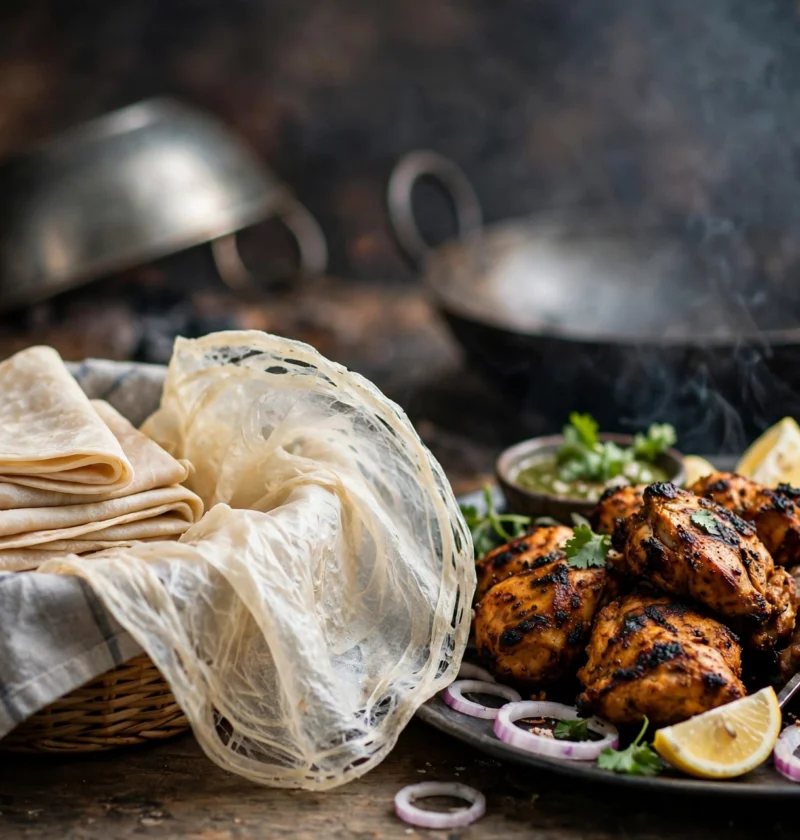
The night I fell for rumali roti, I was not even looking at the food. I was standing at a kabab house, charcoal smoke stinging my eyes, when the roti cook caught my attention — a man behind a huge upturned karahi, slapping a ball of dough between his palms, then tossing it into the air and catching it wider, thinner, every turn, until it floated down like a bedsheet settling over a mattress. He draped that sheet over the dome, waited a heartbeat, peeled it off, folded it into quarters without looking, and dropped it into a cloth-lined basket. Paper could not have folded more softly. The rumali roti recipe below is the one I built at home after that night, chasing that sheet of dough on my own inverted kadhai.
My first attempts were honest failures. I rolled the dough the way I roll a chapati and got a chapati — pleasant, puffed, and about as translucent as a curtain. The next round tore in three places because the dough had rested barely ten minutes and fought me like a rubber band. What finally worked was patience and a bowl of salted water — the two things kabab-house cooks never mention. A soft dough, properly rested, and wet, salty fingers coax it wider than any rolling pin. Get those right, and this rumali roti recipe stops being a performance and becomes a Tuesday-evening skill.
Why This Rumali Roti Recipe Works
A rumali has no filling, no layers, no ghee to hide behind — it is flour, water and technique, judged entirely on thinness. This rumali roti recipe is built around the five things that decide whether yours comes off the dome as silk or as cardboard:
- The atta–maida blend does two jobs at once. Atta brings the nutty flavour and faint golden colour of a real roti; maida brings the elastic stretch that lets the sheet go wider without tearing. All of one or the other gives you taste without thinness, or thinness without taste.
- The dough is soft — softer than chapati dough. A tight, firm dough cannot stretch to transparency; it snaps back or rips. Kneaded smooth and slightly tacky, this one yields under your knuckles instead of resisting them.
- Two full rests relax the gluten. Thirty minutes after kneading, fifteen more after shaping the balls — rested gluten is the difference between a sheet that stays wide and one that shrinks back into a thick disc in your hands.
- Salted water on the hands is the rumali makers’ real trick. Fingers dipped in it before every stretch, the wet, salty film stops the dough clinging to your skin and lets you pull it thinner than dry hands ever could — this is how the kabab-house cook works so fast without a single tear.
- The convex karahi cooks in seconds and the fold finishes the job. The dome’s fierce heat sets the sheet almost on contact, puffing tiny bubbles before it can dry. Folded into quarters the moment it comes off, the roti steams itself limp inside its own layers — that softness is made by the fold, not the flame.
Ingredients for This Rumali Roti Recipe
There is almost nothing in a rumali, which is exactly why each thing matters. The bread itself — rumali roti, also called manda roti — takes its name from the rumal, the handkerchief it is folded to imitate, and it cooks on the convex back of a karahi rather than in any oven. It belongs to the karahi, not the kabab house’s other great fixture, the clay tandoor, whose blazing walls bake naan and roast the seekh kababs this roti wraps. The list is just flour, salt, warm liquid and salted water for your hands — so buy decent atta, and let the dough, not the shopping, do the work.
For the dough
- 1 1/2 cups whole-wheat atta (about 6 1/2 ounces / 185 g)
- 1/2 cup all-purpose flour / maida (about 2 ounces / 60 g), plus a little extra for dusting
- 3/4 teaspoon fine salt
- 1/2 teaspoon sugar (optional, but it helps the spots colour)
- About 3/4 cup (180 ml) warm water, plus more by the spoonful
- 2 tablespoons warm milk
- 1 teaspoon neutral oil, for the surface of the dough
For cooking and serving
- 1 cup (240 ml) water with 1 teaspoon salt dissolved in it, in a wide bowl — for dipping your fingers
- A clean cotton cloth or tea towel, for wrapping the finished rotis
- A few drops of oil, to grease the rested dough balls lightly
How to Make This Rumali Roti Recipe – Step by Step
Step 1: Knead a soft dough and let it rest. Whisk the flours, salt and sugar in a wide bowl. Add the warm water and milk a little at a time, raking with your fingers, until a shaggy mass forms. Knead for a full 8 to 10 minutes — push, fold, turn — until smooth, supple and slightly tacky, softer than chapati dough. If it feels firm, wet your hands and knead the water in; this dough must yield. Oil the top, drape a damp cloth over the bowl, and leave it alone for 30 minutes.
Step 2: Divide into balls and rest them again. Divide the dough into 8 equal pieces, each about the size of a lemon. Roll each between your palms into a smooth, seamless ball, set them on a lightly oiled plate, cover with the damp cloth, and rest another 15 minutes. Do not skip this second rest — it is the one that lets the stretching happen without a fight.
Step 3: Roll a disc, then stretch it paper-thin. Set the inverted karahi heating now (Step 4) so it is ready. On a lightly floured board, roll one ball into a disc about 5 inches (13 cm) across. Dip your fingers in the salted water and lift the disc onto your knuckles. Working hand over hand, turning the sheet constantly and letting its weight pull it wider, stretch it to roughly 12 to 14 inches (30 to 35 cm) — nearly transparent, large print readable through it. Nervous about the toss? Skip the air entirely: pull the edges outward gently on the board, a little at a time, all the way around. Slower, same sheet.
Step 4: Cook it on the dome — seconds, not minutes. The inverted karahi should be hot over a medium-high flame: flick a few drops of water at it and they should hiss and vanish at once (the dome will be around 450°F / 230°C). Drape the sheet of dough over the dome in one confident motion, smoothing out any fold with the back of your fingers. In 20 to 30 seconds the surface will freckle with tiny bubbles and pale golden spots. Lift an edge with your fingertips or tongs, flip it, and give the second side just 10 to 15 seconds. The roti should stay pale and limp, never crisp or browned through — pull it the moment it looks set.
Step 5: Fold it like a handkerchief and keep it wrapped. Straight off the dome, lay the roti on the cotton cloth and fold it in half, then in half again, into a neat quarter — the fold it is named for. Stack the folded rotis in a cloth-lined basket, covered as you go, and work through the remaining balls. Trapped together in the cloth, each softens in its own steam and stays as limp as the kabab-house ones. Serve the basket straight to the table, still wrapped, so the last roti is as soft as the first.
Serving Suggestions
A rumali is not really a side dish; it is the wrapper the whole meal travels in. Tear off a quarter, use it to pinch up a piece of seekh kabab or chicken tikka straight from the skewer, add a strand of raw onion and a squeeze of lemon, and eat the parcel in two bites. Its thinness is the point — you taste charcoal, spice and meat, with the bread as a whisper underneath. It is also the right bread for wrapping boti and malai tikka into soft rolls, and for scooping a runny karahi when nobody is being formal.
Set it beside its bread relatives and the contrasts sharpen it. My sheermal is the festive opposite — saffron and milk kneaded into the dough, baked rich and faintly sweet, a bread so luxurious it is nearly a dish by itself. Rumali is plain and weightless by design: a vehicle, not an event. Then there is my lachha paratha, all architecture — ghee painted on, pleated, coiled, and fried until its layers crisp and separate. A rumali has no layers and never touches frying fat; its entire craft is a sheet stretched thin enough to fold like cloth. This rumali roti recipe is the one I reach for whenever the grill is lit and the kebabs are the headline.
Storage and Reheating
Honestly, rumali roti is a cook-and-eat bread, best within the hour, while the stack is still warm in its cloth. Wrapped in the cloth and sealed in a bag, the rotis stay soft a few hours at room temperature. For longer keeping, refrigerate them folded, interleaved with parchment, for up to 2 days, or freeze them for up to a month.
To reheat, sprinkle each roti with a few drops of water, fold it again, and wrap the stack in a clean damp cloth inside foil; warm it in a 300°F (150°C) oven for about 5 minutes, or pass each roti briefly over a hot dome or dry tawa until it limps again. A short microwave burst — 10 seconds, wrapped in a damp cloth — works in a pinch, but go longer and the edges turn to rubber. The raw dough balls also hold in the fridge for a day, oiled and covered; bring them back to room temperature before stretching, or cold gluten will tear.
Frequently Asked Questions
I do not own a karahi I can invert. Can I use a tawa or a wok?
Yes, with one honest caveat. A wok turned upside down over the flame is the closest substitute — its dome drapes the dough the same way and cooks it evenly, and it is what I use when my kadhai is busy. A flat tawa works too, but lying flat instead of draping, the sheet puffs in patches and cooks a little less evenly; stretch it extra thin to compensate. Use uncoated metal only — a nonstick pan should never sit upside down over a direct flame — and get it properly hot before the first roti lands.
Why does my dough keep tearing or springing back?
Both faults come from tight, rushed gluten. Spring-back means the dough wants more rest: cover the disc and walk away for 10 minutes, and it will stretch willingly when you return. Tearing usually means the dough is too dry or the maida share is too low — knead in a spoonful of warm water, and next time try shifting the blend a little further toward maida. Also stretch from the edges in small pulls rather than hauling at one spot; a sheet this thin forgives patience and punishes force.
Can I make it with atta alone, or maida alone?
You can, and I have done both, so here is the honest account. Atta alone gives the real roti flavour, but the bran snags the stretch — the sheet tears sooner and never quite reaches window-thin, so expect a sturdier rumali. Maida alone stretches like a dream and comes out pale and silky, but tastes of almost nothing and goes gummy as it sits. The blend in this rumali roti recipe is the kabab-house compromise I settled on: enough atta to taste, enough maida to float.
How do restaurants keep rumali rotis soft, and how do I reheat mine without drying them out?
The kabab houses cheat in the simplest way: they barely keep them at all. Each roti is folded the second it leaves the dome and stacked in a covered, cloth-lined basket, where trapped steam keeps the pile limp — and a busy cook makes fresh batches all evening anyway. Copy that system: fold immediately, wrap always, never leave one sitting uncovered. To reheat, moisture is the rescue — a sprinkle of water, a damp cloth, gentle covered heat. A dried-out roti can be softened again; one scorched stiff on the dome is past saving.
Recipe Summary
- Prep time: 20 minutes (plus 45 minutes of resting)
- Cook time: 15 minutes
- Total time: About 1 hour 20 minutes
- Servings: 8 rotis
- Cuisine: Pakistani
- Course: Main Course