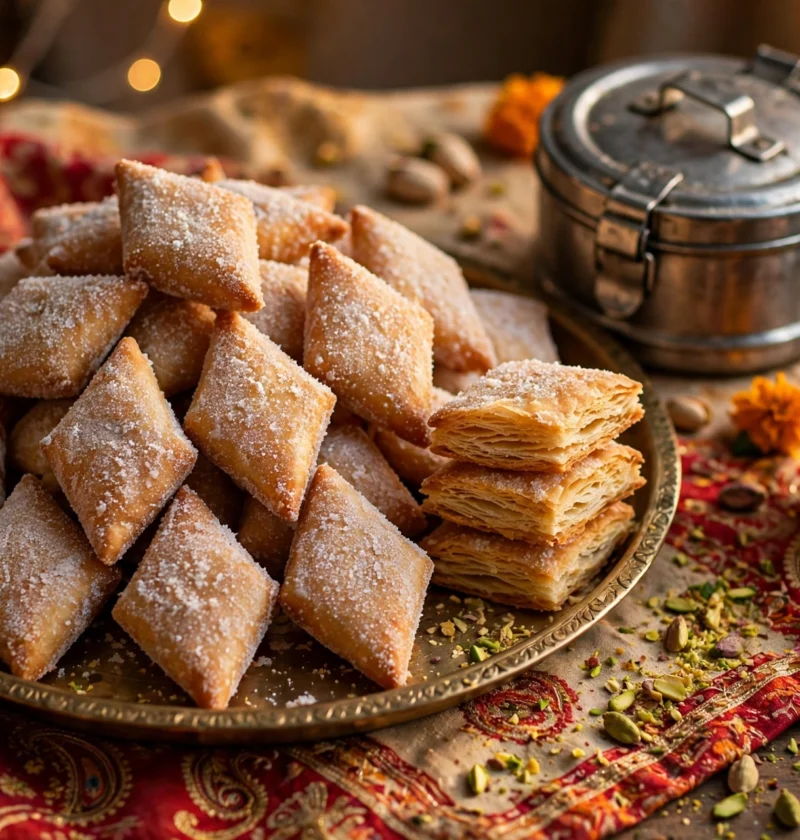
Every wedding I attended as a child ended the same way: not with the rukhsati, but with the small cardboard box pressed into my hands at the door, tied with ribbon and heavy for its size. Inside, packed between layers of tissue, sat the sweets that had been waiting all evening — ladoo, barfi, and always, tucked along one side like pale little tiles, a row of shakarpara. Those frosty diamonds were the first thing I ate in the car on the way home, and this shakarpara recipe is my attempt to keep that exact box-of-wedding feeling alive in my own kitchen, no shaadi required.
What happened to the rest of the batch tells you everything about this snack. My mother would transfer the wedding leftovers — and later, the ones she fried herself before Eid — into a dented steel dabba that lived on the kitchen counter, out of casual reach. It never worked. For weeks afterward, every trip past that counter ended with the lid lifted and a handful gone, usually alongside the evening chai nobody had officially announced. A good shakarpara recipe has to survive that treatment: it must stay crisp in the tin, sweet without being sticky, and sturdy enough to travel in a box yet tender enough to shatter politely. That is the standard this version is built to meet.
Why This Shakarpara Recipe Works
Shakarpara looks like the simplest mithai on the tray — flour, ghee, sugar, a hot pan of oil — but the gap between a crisp, flaky diamond and a hard, greasy one is decided by five disciplines. This shakarpara recipe is organized around all five:
- The moyan is measured by fist, not by guesswork. Ghee rubbed into the flour until the mixture resembles coarse crumbs is what makes the layers flake; too little and the diamonds fry up hard, too much and they drink oil and slump. The old test never lies — squeeze a fistful of the crumbed flour, open your hand, and it should hold its shape like a rough snowball before crumbling at a touch.
- The dough rests before it is rolled. Twenty to thirty minutes under a damp cloth lets the flour hydrate and the gluten relax, so the sheet rolls out evenly without springing back or tearing. Rested dough cuts into clean diamonds; impatient dough fights the knife and shrinks in the oil.
- The sheet is rolled to an honest quarter inch. Thinner than that and the pieces brown before their centers crisp, leaving you sweet crackers that scorch at the tips. At a quarter inch, the diamond puffs very slightly, cooks through, and keeps a delicate, layered bite.
- The frying is low and unhurried. Oil around 300°F, never smoking, and batches that barely color for the first few minutes. Shakarpara crisp from the inside out; if the oil is hot enough to turn them golden quickly, the middle stays raw and softens the whole piece within a day.
- The syrup stops at one string. A syrup cooked to the one-string stage coats each diamond in a thin glaze that dries as it cools into that signature frosty white shell. Thinner syrup soaks in and turns the batch soggy; thicker syrup sets into a hard, tooth-threatening crust. One string is the whole secret.
Ingredients
Few sweets travel as well across the subcontinent as shakarpara, the diamond-cut mithai that appears at Diwali in one home, on an Eid dastarkhwan in another, and in wedding boxes in both. The recipe changes a little from kitchen to kitchen — some families sweeten the dough itself and skip the syrup, others roll in a pinch of semolina for extra crunch — but the architecture never changes: a short, ghee-rich dough, a patient fry, and a sugar finish. It is the ghee that does the quiet heavy lifting here, giving the crumb its shortness and that unmistakable mithai-shop aroma, so use the good kind, the one that smells faintly nutty straight from the jar. Everything else in this shakarpara recipe is pantry basics, because with so few ingredients there is nowhere for an error to hide.
Makes about 40 pieces
For the dough:
- 2 cups all-purpose flour
- 1/4 cup ghee, melted and slightly warm (for the moyan)
- 1/4 teaspoon salt
- 1/2 teaspoon ground cardamom
- 1/3 to 1/2 cup warm water, as needed
For frying:
- Neutral oil or ghee, enough for 2 inches depth in your pan (about 3 cups)
For the sugar syrup:
- 3/4 cup granulated sugar
- 1/3 cup water
- 1 teaspoon lemon juice (keeps the syrup from crystallizing in the pot)
- 1/4 teaspoon ground cardamom
- 1 tablespoon crushed pistachios, for sprinkling (optional)
How to Make This Shakarpara Recipe – Step by Step
Step 1: Rub in the moyan, knead a firm dough, and let it rest. Tip the flour, salt, and cardamom into a wide bowl and pour over the warm melted ghee. Rub the fat into the flour with your fingertips, lifting and crumbling, until the mixture looks like coarse breadcrumbs and smells faintly sweet. Now perform the test this shakarpara recipe stands or falls on: gather a fistful and squeeze. It should clump and hold the shape of your fist. If it falls apart dry, rub in another teaspoon of ghee. Then add warm water a spoonful at a time, kneading to a firm, smooth dough — firmer than roti dough, closer to a pie crust. Cover with a damp cloth and rest it for 30 minutes.
Step 2: Roll the sheet and cut your diamonds. Divide the rested dough in half and keep one piece covered. On a lightly floured surface, roll the other into a sheet a good 1/4 inch thick, turning it once or twice so it rolls evenly and does not stick. Trim the ragged edges straight with a sharp knife or pizza wheel, then cut the sheet into strips about 1 inch wide, and cut across those strips diagonally to form diamonds. Gather the trimmings, rest them a few minutes, and re-roll. Lay the cut diamonds on a tray in a single layer — this pause lets their surfaces dry slightly, which helps them fry up crisp.
Step 3: Fry low and slow until pale gold and crisp through. Heat the oil in a deep, heavy pan over medium-low heat until it reaches about 300°F; a test diamond should sink, gather small lazy bubbles, and rise slowly rather than sizzling violently. Slide in a batch that fits without crowding and fry, turning gently, for 8 to 10 minutes, until the pieces are a pale, even gold and feel light and hard when lifted on the slotted spoon. Let the oil return to temperature between batches. Drain the shakarpara on a wire rack or paper towels and let every batch cool completely — they crisp further as they cool, and warm pieces would melt their own syrup coating into a sticky gloss.
Step 4: Cook the syrup to exactly one string. While the last batch cools, combine the sugar and water in a clean, wide pan and bring it to a boil, stirring until the sugar dissolves. Add the lemon juice and cardamom, then simmer for 3 to 4 minutes. To test, dip a spoon, let a drop cool for a few seconds, and press it between your thumb and forefinger: as you pull them apart, a single thread should stretch and hold. That is one string. Take it off the heat immediately — another minute of boiling and you are heading toward a hard shell instead of a frosty one.
Step 5: Coat the diamonds and let the shell set frosty. Tip all the cooled shakarpara into the warm syrup at once and toss continuously and gently with a wide spatula, lifting and turning so every face gets its glaze. Keep tossing as the syrup cools and begins to turn opaque; within 2 to 3 minutes it will whiten and cling in that dry, snowy coating you are after. Spread the pieces out on a tray in a single layer, sprinkle with crushed pistachios if you are using them, and leave them undisturbed for 15 minutes to set completely. Only then do they go into the dabba — and this shakarpara recipe is officially ready to start disappearing.
Serving Suggestions
Shakarpara were born for the in-between moments of a gathering: the pause between courses at a wedding, the tray that circulates while the Eid guests are still arriving, the small plate that appears beside evening chai without anyone remembering who fetched it. Set them out in a wide shallow bowl rather than a deep one, so the frosty coating stays visible and the pieces do not knock their sugar off against each other. They are equally at home on a meetha platter alongside barfi and ladoo, and on the iftar dastarkhwan in Ramadan, where their dry sweetness sits kindly after dates and a glass of water.
For a proper tea-time spread, the dabba logic applies — everything within arm’s reach of the chai. I line a tray with these diamonds, a plate of my nan khatai for the crumble-lovers, and a pot of strong doodh patti chai poured small and often. Between the shattering khatai, the flaky shakarpara, and milky chai strong enough to stand a spoon in, nobody at that table checks the time. It is the combination my family has served to condolence visitors and celebration guests alike, because some trays are simply correct for every occasion.
Storage and Reheating
No mithai rewards a big batch like the one from this shakarpara recipe: let the coated pieces cool and set completely, then pack them into a clean, completely dry airtight tin — the classic steel dabba earns its reputation here — with a sheet of parchment between layers if you stack them, and they will stay crisp at room temperature for 3 to 4 weeks, away from steam and sunlight. Humidity is the only real enemy, so never seal the tin while the pieces carry even a whisper of warmth. If a stored batch ever loses its snap to a damp week, spread the pieces on a baking sheet and refresh them in a 250°F oven for 5 to 7 minutes, then cool fully before re-tinning; the crunch returns, and the frosty shell survives the trip untouched.
Frequently Asked Questions
Why did my shakarpara turn out soft instead of crisp?
In any shakarpara recipe, the usual culprit is oil that was too hot or pieces rolled too thick. If the outside colors quickly, the center never dries out, and a too-thick diamond traps moisture no amount of frying will fix. Roll to a true 1/4 inch, keep the oil near 300°F, and give each batch its full time; the pieces should feel hard and light the moment they leave the oil, and they crisp a little further as they cool.
Can I skip the syrup and sweeten the dough instead?
Yes — that is the other traditional branch of the shakarpara recipe family, and many families swear by it. Add 1/3 cup powdered sugar to the flour before the moyan, fry the diamonds a touch deeper to a fuller gold, and dust lightly with more powdered sugar while warm. The result is less frosty and a little less sweet, with the sugar woven through the crumb instead of sitting on the surface. Both versions keep beautifully; the syruped one simply wears the wedding-box look.
My syrup turned into hard crystals in the pan. What went wrong?
The syrup cooked past the one-string stage, or it was stirred after it began to cool and seized into crystals. Rescue is possible: add 2 tablespoons of hot water, return the pan to low heat, and stir gently until it melts back to a smooth syrup, then test again and stop the moment you see a single thread. The lemon juice in this shakarpara recipe is there precisely to guard against this, so do not leave it out.
Can I bake shakarpara instead of frying them?
You can, and for a lighter batch many home cooks do: arrange the cut diamonds on a parchment-lined sheet, brush very lightly with melted ghee, and bake at 350°F for 15 to 18 minutes, turning once, until pale gold at the edges. They will be crisp and pleasant, though honestly less flaky, because frying is what puffs the moyan layers apart. Coat them in the same one-string syrup and the difference narrows — but for a wedding tray, I still reach for the karahi.
Recipe Summary
- Prep time: 20 minutes, plus 30 minutes of dough resting
- Cook time: 35 minutes
- Total time: About 1 hour 30 minutes
- Servings: About 40 pieces
- Cuisine: Pakistani
- Course: Snack / Dessert