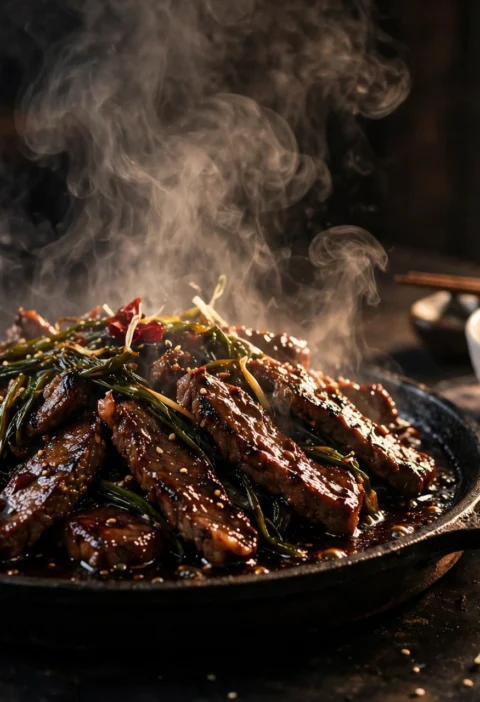
My mamoo ran a six-table dhaba near Lahore’s railway station, and travellers planned their layovers around his karahi. His bhuna gosht recipe was the dish they crossed the city for: mutton so dark it was nearly mahogany, wearing its masala like a coat instead of swimming in it. He cooked it in a karahi big enough to bathe a toddler in, standing over it with a long steel spoon, and his whole philosophy fit in one sentence: “Beta, bhuna is not made with water. It is made with patience — the water is just an excuse to keep frying.”
That sentence confused me for years, because you do see water go into the pot. But it goes in by the splash, never the jug — a handful at a time, each splash hissing, loosening the browned masala from the pan’s bottom, and frying away before the next one lands. Repeat that rhythm for the better part of an hour and something alchemy-like happens: the onion-tomato masala gives up being a sauce and becomes a dark, glossy shellac on the meat. This is the version I finally coaxed out of him, shrunk to a home stove.
Why This Bhuna Gosht Recipe Works
A bhuna lives or dies on reduction, and reduction cannot be rushed or faked. This bhuna gosht recipe is built on five habits, all borrowed from my mamoo’s side of the karahi:
- The masala is fried down in stages, not simmered once. Splash, scrape, fry, reduce — then again. Each cycle lays down another layer of browned flavour, the way repeated coats of varnish deepen wood. A single long simmer in plenty of water gives you a curry; only the staged frying gives you a bhuna.
- The onions go properly dark before anything else joins them. Not pale gold, not translucent — deep, even amber, right at the edge of biryani colour. That darkness gives the dish both its colour and its faint sweetness; no spice in the rack can substitute for it.
- The mutton is browned hard, on its own, first. Deep colour on the meat and a pan full of fond before the masala even starts. That fond dissolves into the onions and becomes part of the coating, so the meat tastes roasted rather than stewed.
- A little yogurt rides in with the tomatoes. It brings a gentle tang plain tomato lacks, helps the masala grip the meat, and fries down to nothing visible — a batch without it tastes strangely unfinished.
- The last five minutes are loud. Lid off, heat up, spoon never still, until the masala tightens, darkens and shines with separated oil. That final open-pan fry is the difference between mutton in thick gravy and true bhuna — glossy, clinging, almost dry.
Ingredients for This Bhuna Gosht Recipe
Bhuna names a technique before it names a dish — a style of frying and reducing that travelled from Bengal into kitchens all across the region, ours included. The meat is goat meat, which is what “mutton” means on our side of the world; look for bone-in shoulder at a desi or halal butcher, where the staff will cut it to size without blinking. One deliberate choice: the fat here is plain oil, or oil with a spoon of ghee — not mustard oil. Mustard oil has its own dishes where it is irreplaceable; in a bhuna it shouts over the browned onions, which are meant to be the loudest voice in this pot.
For the mutton
- 2 pounds (900 g) bone-in goat mutton, mostly shoulder with a few shank pieces, cut into chunks about 2 inches across
- 1 teaspoon fine sea salt, for seasoning the meat
- 1/2 cup (120 ml) neutral oil, or 1/3 cup oil plus 2 tablespoons ghee
Whole spices
- 1 teaspoon cumin seeds
- 2 black cardamom pods, bruised
- 4 green cardamom pods, bruised
- 1 cinnamon stick (about 3 inches)
- 2 bay leaves
- 6 whole cloves
For the masala
- 3 large onions (about 1 pound / 450 g), halved and sliced thin
- 2 tablespoons ginger-garlic paste
- 3 medium tomatoes (about 12 ounces / 340 g), chopped rough
- 1/3 cup (80 g) plain whole-milk yogurt, whisked until it pours
- 2 teaspoons ground coriander
- 1/2 teaspoon turmeric powder
- 1 teaspoon Kashmiri chili powder, for colour
- 1 teaspoon hot red chili powder
- 1 1/2 teaspoons fine sea salt, or to taste
- Hot water, kept ready in a kettle — you will use roughly 1 1/2 cups (360 ml), a splash at a time
To finish
- 1 teaspoon garam masala
- 1/2 teaspoon coarsely ground black pepper
- A 2-inch piece of fresh ginger, cut into fine julienne
- 3 or 4 green chilies, slit lengthwise
- A handful of fresh cilantro, chopped rough
- Lemon wedges, for the table
How to Make This Bhuna Gosht Recipe – Step by Step
Step 1: Season the mutton and brown it like you mean it. Pat the meat dry — wet mutton steams instead of browning — and toss it with the teaspoon of salt. Heat the oil in a wide, heavy karahi or Dutch oven over medium-high until it shimmers, then lay in the mutton in a single uncrowded layer, working in two batches if your pan demands it. Leave each batch alone for a full 3 minutes before turning, so a deep crust forms; brown all sides, about 8 minutes per batch. Lift the meat out to a plate, juices and all, and keep every drop of the browned oil in the pan.
Step 2: Take the onions to dark amber. Lower the heat to medium and slide the sliced onions into that same oil along with a pinch of salt. Cook them slowly, stirring every few minutes, for 15 to 18 minutes, until they shrink, soften and turn an even deep amber — the colour is the assignment here, so do not accept pale gold and move on. In the final minute, stir in the cumin seeds, both cardamoms, cinnamon, bay leaves and cloves, then the ginger-garlic paste, and fry 2 minutes more until the raw smell cooks off and the whole pan smells like a restaurant corridor.
Step 3: Build the masala and fry it to the oil. Add the chopped tomatoes, the whisked yogurt, ground coriander, both chili powders, turmeric and the salt. Now the first true bhunao: fry this mixture over medium-high heat for 10 to 12 minutes, stirring and scraping the bottom constantly as it thickens. The tomatoes will collapse, the yogurt will vanish, the colour will deepen to brick, and beads of oil will appear at the edges and across the surface. That oil is your signal — it means the water has left and the spices are frying, not boiling.
Step 4: Return the mutton and settle into the rhythm. Put the browned mutton and its resting juices back into the masala and turn everything together for 2 minutes, so each piece is painted. Splash in about half a cup of hot water, clamp the lid on, and drop the heat to low for 15 minutes. Then uncover and fry over medium heat, stirring and scraping, until the liquid reduces and the masala thickens and grips again, 4 to 5 minutes. Repeat the whole cycle — splash, lid, simmer, open fry — two or three more times, until the mutton is fully tender, giving under a spoon but not falling apart; expect 45 to 55 minutes of this, and less water each round as the meat softens.
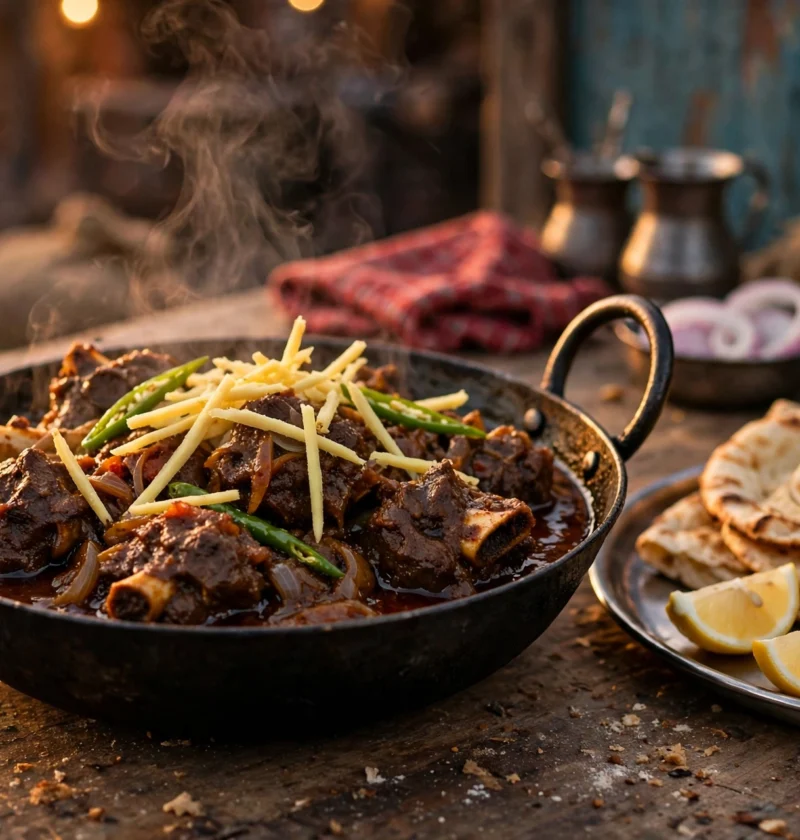
Step 5: The loud finish — fry it dry and dress it. With the meat tender, take the lid off for good, raise the heat to medium-high, and fry hard for 4 to 5 minutes, folding the meat through the masala without pause, until what remains is a dark, glossy coating that clings to every piece and the oil glistens separately around them. Scatter over the garam masala and black pepper, fold once more, and take the pan off the heat. Shower the top with ginger julienne, slit green chilies and cilantro, rest it 10 minutes, and carry it to the table with lemon wedges alongside.
Serving Suggestions
Bhuna gosht wants bread, full stop — naan, tandoori roti or a rumali roti thin enough to wrap a piece and its coating in one fold. Rice is a respectable second choice, but keep it plain or a jeera rice; a masala-heavy pulao fights the main event. On the table there should be nothing more than sliced onions, lemon wedges and a plain cucumber raita for whoever finds the heat ambitious. In my mamoo’s dhaba it arrived still in the karahi, and nobody complained about the informality.
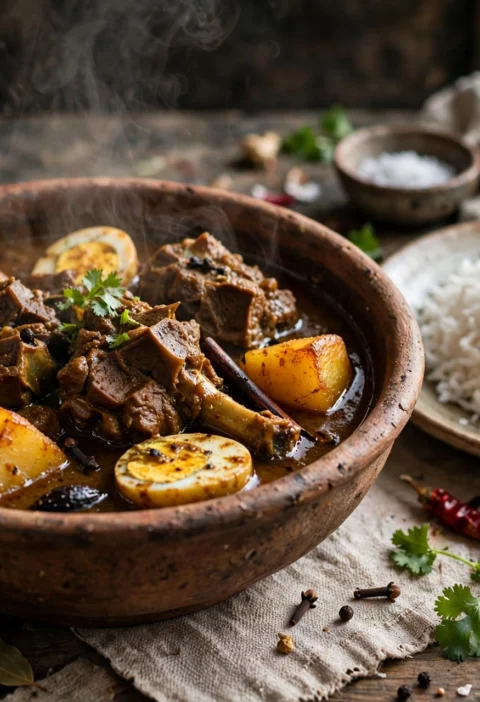
It also helps to place this bhuna gosht recipe next to its mutton cousins so the differences stand up. My kunna gosht is its opposite in temperament — a slow clay-pot stew with a loose, soupy gravy you are meant to mop up by the bowlful. My laal maas builds its heat on a ground chili paste and mustard oil, a gravy dish through and through, red as a warning light. Bhuna is the dry one of the family: the gravy has been cooked nearly out of existence on purpose, and what is left clings.
Storage and Reheating
Few curries keep as gracefully as this bhuna gosht recipe. Refrigerated, it holds for 3 days, and it freezes well for up to 2 months — portion it with all its coating, because there is no thin gravy to break or separate. Overnight, the masala relaxes into the meat and day two is, honestly, the best seat at this particular table. Reheat it the way it was born: in an open pan over medium heat, a splash of water added, frying and folding for 3 to 4 minutes until the coating loosens, darkens and shines again. A microwave will make it hot, and that is all it will do — the gloss and the grip come back only in the pan.
Frequently Asked Questions
How wet or dry should this bhuna gosht recipe finish?
Drier than your instincts suggest. Drag a spoon across the pan’s bottom and it should leave a trail that stays visible for a few seconds; the meat should look lacquered, with oil glistening around the pieces rather than pooling under them. If you overshoot into genuinely dry — masala stiff, meat looking thirsty — the rescue is easy: add a quarter cup of hot water and fry 2 minutes, and it relaxes back. Too wet is equally fixable: lid off, heat up, five honest minutes of frying.
Can I make it with beef or lamb instead of goat mutton?
Yes, with the clock adjusted. Beef chuck, cut the same 2-inch size, is richer and needs longer — plan 1 1/2 to 2 hours of the splash-and-fry rhythm, adding a splash more water per round. Lamb shoulder is the gentle option, tender in roughly 45 to 55 minutes and a little fattier; skim only if a full slick of oil forms. Keep the pieces big whichever meat you choose — small cubes dry out during the final hard fry, before the masala can protect them.
Why does the masala keep catching on the bottom and threatening to burn?
Because reduction is concentration: as the water leaves, sugars and ground spices settle and want to scorch — that tension is the dish, not a flaw in your cooking. Manage it the dhaba way: a heavy pan, a flat spoon that reaches the corners, and the rhythm itself — the moment the masala starts gripping the bottom hard, that is your cue for the next splash of hot water and a thorough scrape. Where cooks go wrong is either walking away during an open fry or adding cold water, which stalls everything. If a batch does catch and smells bitter, quietly move the meat and loose masala into a clean pan, leaving the blackened layer behind, and carry on.
Can I use a pressure cooker to save time?
You can, and on a weekday I sometimes do — but go in with open eyes. Pressure tenderises beautifully and cuts the simmering to about 15 minutes at pressure, yet it traps steam, so no gradual reduction happens inside; the masala comes out tasting steamed rather than fried, a step flatter. The workable compromise: build and fry the masala fully on the stove first, pressure-cook the meat in it, then return everything to the open pan for a real 8 to 10 minutes of bhunao at the end. You will land at about ninety percent of the slow version, which on a Tuesday is a bargain worth taking.
Recipe Summary
- Prep time: 20 minutes
- Cook time: 1 hour 20 minutes
- Total time: About 1 hour 40 minutes
- Servings: 4 to 5
- Cuisine: Pakistani
- Course: Main Course