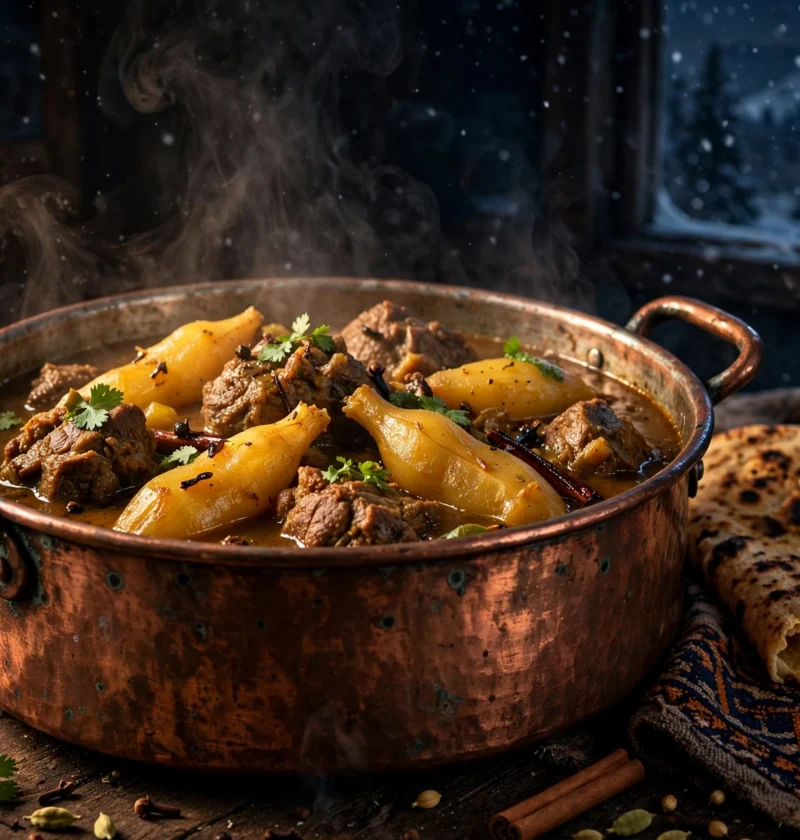
“Shab” means night, and “deg” means the great cauldron — and the first time someone explained shab deg to me, I thought they were describing a fairy tale. A Kashmiri friend told me about the winters of her childhood in Srinagar, when her grandmother would put mutton and turnips into the deg at dusk, bank the coals low, and let the pot murmur to itself all night long. At dawn, the whole house would wake to a smell so deep it felt like a blanket. The turnips had dissolved into sweetness, the mutton had surrendered completely, and the gravy was dark as winter earth. I did not believe a turnip could do that until I made it myself. This shab deg recipe is that overnight miracle, adapted for a home kitchen: mutton and turnips, sealed low, cooking while you sleep, ready when the morning is cold.
My first attempt failed because I treated the night like a suggestion. I put the pot on at nine, got impatient at midnight, cranked the heat to “finish it faster,” and woke a household to the smell of scorched turnips. The second time, I did what the grandmother would have done: lowest possible flame, a heavy lid, a folded towel sealing the rim, and then I walked away and trusted the dark. Eight hours later I lifted that lid on a pot of pure winter — the meat falling off the bone, the turnips melted into the gravy, the whole thing glossy and deep. The lesson of this shab deg recipe is embarrassingly simple: the night does the cooking. Your job is to set the stage and go to bed.
Why This Shab Deg Recipe Works
Shab deg is the only overnight pot in the Kashmiri repertoire, and it works on patience plus five decisions. This shab deg recipe keeps all five:
- The cook is genuinely overnight — eight hours, no peeking. This is not a figure of speech. The mutton and turnips go in at night on the lowest possible flame, and the pot stays sealed until morning. Those eight hours are what dissolve the turnips’ sharpness into sweetness and reduce the mutton to tenderness. In this shab deg recipe, the clock is an ingredient.
- Turnips go in early and in quantity. A full kilo of turnips, quartered, layered over the meat — they are not a garnish, they are half the dish. Over the long night they release their juices, mellow completely, and thicken the gravy with their own sweetness. This shab deg recipe uses turnips the way other curries use onions: as the foundation.
- The spice hand stays warm and simple. Fennel, dry ginger, Kashmiri chili, whole garam masala — the Kashmiri winter palette, nothing sharp, nothing that fights the turnips’ sweetness. No tomatoes, no tang. This shab deg recipe is built for cold weather: every spice in it warms rather than bites.
- Mustard oil gives the authentic edge. Traditional shab deg starts in mustard oil, heated to smoking and cooled slightly before the spices go in. That pungent, earthy base note is unmistakable and irreplaceable — it is the flavor that tells you this shab deg recipe comes from a Kashmiri winter kitchen, not a restaurant.
- The meat is bone-in and fatty. Shoulder or shank with the bone in, some fat left on — the long night renders it all into the gravy, and the bones give up their gelatin. Lean, trimmed meat would dry out over eight hours; this shab deg recipe wants the generous cuts, the ones that get better the longer they cook.
Ingredients
Serves 8 (shab deg is always made in quantity — it is winter food for a crowd)
For the pot:
- 3 lbs (1.4 kg) bone-in mutton (shoulder or shank), cut into large 3-inch pieces
- 2 lbs (900g) turnips (shalgam), peeled and quartered
- 1/3 cup (80 ml) mustard oil
- 2 large onions (about 400g), sliced thin
- 2 tablespoons ginger-garlic paste
Spices:
- 2 tablespoons fennel powder (saunf)
- 1 tablespoon dry ginger powder (sonth)
- 2 tablespoons Kashmiri red chili powder
- 1 teaspoon turmeric
- 1 teaspoon cumin powder
- 5 green cardamom pods, 5 cloves, 2-inch cinnamon stick, 2 bay leaves, 1 black cardamom
- 2 1/2 teaspoons fine salt (more to taste)
- 1 1/2 cups plain whole-milk yogurt, whisked smooth
To finish:
- 1 teaspoon garam masala
- 3 tablespoons fresh coriander leaves, chopped
- 1-inch piece fresh ginger, cut into fine juliennes
The two souls of this dish deserve their names. The turnip — humble, peppery when raw, meltingly sweet after a long braise — is the vegetable that makes shab deg unlike any other meat curry in the subcontinent; eight hours in the deg transforms it completely. And the tradition belongs to Kashmir, where winter cooking is a cuisine of its own: overnight pots, warming spices, and dishes designed to be eaten steaming while snow falls outside. This shab deg recipe is that winter on a plate.
How to Make This Shab Deg Recipe – Step by Step
Step 1: Prepare the mustard oil base.
Heat the mustard oil in your heaviest, largest pot — a Dutch oven or a proper deg if you have one — until it just begins to smoke, then pull it off the heat for a minute to cool slightly. This tames the raw pungency while keeping the flavor. Return to medium heat, sizzle the whole spices for 30 seconds, then add the sliced onions and cook 10 to 12 minutes until richly golden. Add the ginger-garlic paste and cook 2 minutes more. The base of this shab deg recipe should smell rich and earthy before the meat ever arrives.
Step 2: Layer in the mutton and spices.
Add the mutton pieces and turn them in the onion base for 8 to 10 minutes until opaque all over. Stir in the fennel powder, dry ginger, Kashmiri chili, turmeric, cumin, and salt, coating every piece, and cook 5 minutes more until the spices darken slightly and the oil begins to glisten. Lower the heat, stir in the whisked yogurt a spoonful at a time — tempering it the same careful way as any yogurt gravy — and let it come together into a thick, red masala clinging to the meat.
Step 3: Add the turnips and seal for the night.
Pour in 4 cups of hot water and bring the pot to a gentle boil. Layer the quartered turnips over the meat — they will sink and settle as the night goes on. Cover with the heaviest lid you own; if the lid is light, lay a clean folded kitchen towel over the pot under the lid to seal the steam in. Drop the flame to its absolute lowest — the pot should barely murmur, not bubble. This is the moment this shab deg recipe hands the cooking over to the night.
Step 4: Sleep. Let the night work.
Leave the pot completely alone for 7 to 8 hours. Do not lift the lid to check — every peek releases the steam the dish is built on. The turnips will collapse into the gravy, the mutton will go spoon-tender, and the spices will marry into something no quick curry can imitate. If your stove cannot safely hold its lowest flame overnight, a heavy pot in a 225°F (110°C) oven with the lid sealed works just as well. This shab deg recipe rewards trust: set it, seal it, sleep.
Step 5: Wake the pot and finish.
In the morning, lift the lid on eight hours of winter. Stir gently — the turnips should be melting, the meat falling off the bone, the gravy thick, dark, and glossy. If the gravy looks thin, simmer uncovered 15 to 20 minutes until it clings. Stir in the garam masala and taste for salt; the long night concentrates everything, so season at the end. Serve this shab deg recipe steaming hot, scattered with coriander and ginger juliennes, with tandoori roti for scooping up the gravy.
Serving Suggestions
This shab deg recipe is winter breakfast and dinner in one — in Kashmir it is eaten steaming at dawn, and there is no better way. Tandoori roti or thick, rustic rotis are essential for scooping; the gravy is too good to leave in the pot. Plain steamed rice works too, though bread is traditional. On the side, nothing fancy: sliced onion, lemon wedges, green chilies, and a pot of kahwa or doodh patti afterward, the way a Kashmiri winter morning demands.
It shares the slow-cooked shelf with two very different cousins on this site. My mutton handi is the quick, tomato-rich handi curry — bold, bright, done in under an hour — while this shab deg recipe is its photographic negative: no tomatoes, eight hours, turnips instead of tomatoes, winter instead of fire. And my namkeen gosht is the other minimalist mutton pot here — salt, pepper, and patience — where the shab deg adds the Kashmiri spice palette and the overnight turnip melt. Three mutton pots, three philosophies: the handi for speed, the namkeen for purity, the shab deg for the night itself.
Storage and Reheating
This shab deg recipe keeps 4 to 5 days refrigerated, and — like all long braises — it improves for a day or two as the turnip sweetness settles fully into the gravy. Reheat gently in a heavy pot over low heat with a splash of hot water; the turnips will continue to melt, which only improves the texture. The microwave works in bursts with stirring, but the stovetop is kinder. It freezes for up to 3 months in portions — thaw overnight in the fridge, reheat slowly, and finish with fresh coriander. A reheated shab deg on a cold evening is one of the great comforts of the desi kitchen.
Frequently Asked Questions
Can I shorten the overnight cook?
You can, but it stops being shab deg. A 4-hour braise gives you tender mutton and soft turnips — a fine curry — but not the dissolved, married, deep-winter character that eight hours creates. The turnips need the full night to melt into the gravy, and the name of the dish is literally “the night pot.” This shab deg recipe is built around the overnight cook; shortening it makes a different, lesser dish.
I don’t like turnips. Can I substitute?
Honestly? Then make a different curry. The turnip is not optional in shab deg — it is half the dish, the ingredient the whole pot is named around in spirit. That said, if turnips are truly unavailable, daikon radish (mooli) behaves similarly over a long braise. But this shab deg recipe begs you to give turnips their one great moment: eight hours turns their peppery bite into honeyed sweetness, and skeptics convert at the first spoonful.
Is it safe to leave a pot on the stove overnight?
Only on the lowest possible flame, in a heavy pot with a tight lid, and only if your stove holds a steady low simmer — a flame that could blow out or a pot that boils dry is not safe. The safer modern method, and the one this shab deg recipe fully endorses: after step 3, put the sealed pot in a 225°F (110°C) oven overnight instead. Same eight hours, same result, zero worry. The night does the work either way.
How is shab deg different from rogan josh?
Both are Kashmiri, both use the fennel-dry ginger palette, but they are different dishes entirely. Rogan josh is a yogurt-based braise of mutton alone, cooked for about ninety minutes, with a clean, burnished gravy. This shab deg recipe cooks mutton with a mountain of turnips for eight hours overnight — the turnips melt into the gravy, sweetening and thickening it into something darker, deeper, and unmistakably wintry. Same spice family, different universe.
Recipe Summary
- Preparation: 25 minutes
- Cooking: 8 hours (overnight, mostly unattended)
- Total: about 8 1/2 hours
- Servings: 8
- Cuisine: Kashmiri
- Course: Main