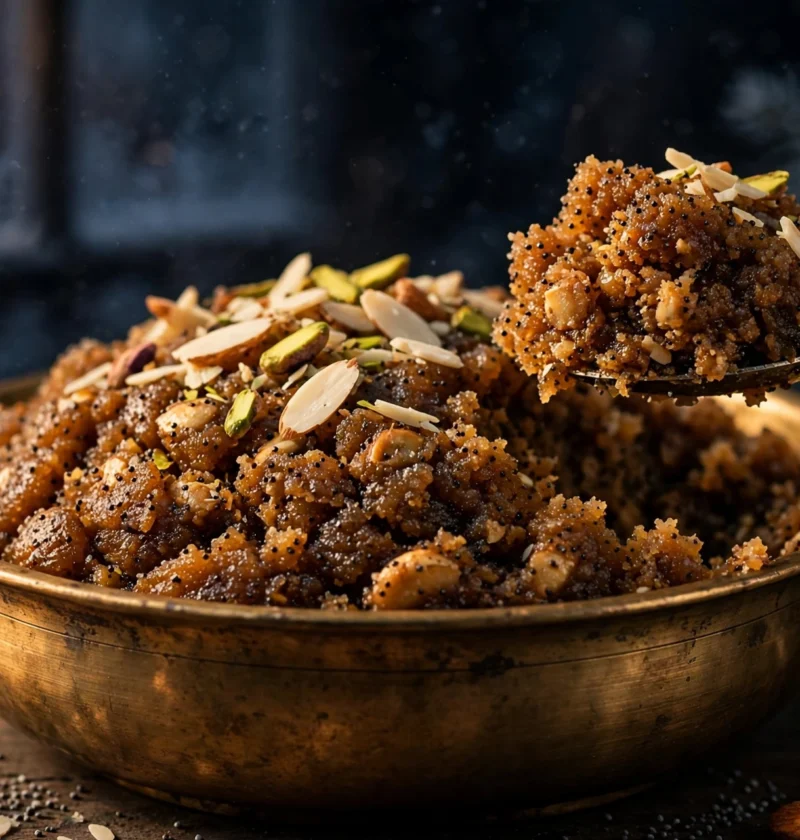
Winter in Lahore has a smell, and for the first ten years of my life I thought it was just “cold.” It was my dadi who corrected me: it was ghee, roasting nuts, and something earthy underneath that I could not name. That something was khas khas — poppy seeds — which she soaked overnight every December and ground at dawn on the sil-batta, her breath fogging in the kitchen, while the rest of the house was still asleep. By the time we woke up, the halwa was already dark and glossy in the kadhai, and the whole house smelled like the season itself. This khas khas ka halwa recipe is hers, and I have made it every winter since she stopped being able to — because some recipes are not recipes, they are heating systems.
My first attempt, made in the arrogance of my twenties, taught me why she ground those seeds at dawn instead of buying them pre-ground. I blitzed dry poppy seeds in a spice grinder, tossed the coarse meal into milk, and produced a halwa with the texture of wet sand and a bitterness that lingered like a grudge. She tasted it, patted my cheek, and said the soaking was not optional, the grinding was not optional, and neither was the patience. She was right on all three counts. Soaked overnight until swollen, ground with milk to an actual paste, cooked slow — that is the entire difference, and this khas khas ka halwa recipe does not skip a minute of it.
Why This Khas Khas Ka Halwa Recipe Works
Poppy seeds are unforgiving: treat them casually and you get grit and bitterness; treat them properly and you get the nuttiest, most warming halwa in the winter repertoire. This khas khas ka halwa recipe treats them properly, in five steps:
- The seeds soak overnight and grind to silk. Twelve hours in water swells the seeds and softens their bite; grinding them with a little milk — in a wet grinder or a powerful blender, in batches — produces a smooth gray paste, not a gritty meal. Run it through your fingers: if you feel grain, grind more. In this khas khas ka halwa recipe, the paste is the dessert; everything after it is seasoning.
- Milk goes in first, before any ghee. The poppy paste simmers in milk for a full 15 minutes before the ghee arrives, which cooks out the raw edge and the faint bitterness that dry-ground seeds carry. Milk-first also keeps the paste from catching on the pan bottom during the long roast. Every bitter khas khas ka halwa recipe I have tasted added the ghee too early and the milk too late; order matters more than quantity here.
- The ghee bhunai runs a full 30 minutes. Once the milk cooks down, the ghee goes in and the real work starts: medium-low heat, constant stirring, until the mixture darkens to a deep bronze and the ghee begins to separate and glisten at the edges. That separation is the same signal as in every great halwa — it means the moisture is gone and the roast is complete. This khas khas ka halwa recipe is done when the ghee surrenders, not before.
- Sugar goes in late, never early. Sugar added to the raw paste would caramelize during the long roast and turn the halwa bitter and dark in the wrong way. It goes in only after the bhunai is complete, stirred through the hot mixture where it dissolves in minutes. In this khas khas ka halwa recipe, sweetness is a finisher — the roast is the flavor, and the sugar just frames it.
- Khoya and nuts arrive at the very end. Crumbled khoya folded through in the last five minutes adds a milky softness that keeps the dense poppy base from eating too heavy, and the toasted nuts go on top, not in — so they stay crunchy against the soft halwa. Cardamom throughout, because some things are law. This khas khas ka halwa recipe finishes the way winter food should: rich, warm, and unapologetic.
Ingredients
Serves 8-10 (about 4 cups)
For the halwa:
- 1 cup (150g) poppy seeds (khas khas), soaked overnight in water
- 2 cups (480 ml) whole milk, plus 1/2 cup more for grinding
- 3/4 cup (170g) ghee
- 3/4 cup (150g) sugar
- 1/2 cup (125g) khoya, crumbled (optional but recommended)
- 1/2 teaspoon cardamom powder
To finish:
- 1/4 cup sliced almonds, lightly toasted
- 1/4 cup sliced pistachios, lightly toasted
- 1/4 cup walnuts, roughly chopped
- 2 tablespoons chironji or melon seeds
The seed at the center of this is the poppy seed — tiny, slate-blue, and nearly half oil by weight, which is why it grinds into something so rich and why it has warmed winter tables from Lahore to Lucknow for centuries. And the medium of the whole operation is ghee, clarified butter with the milk solids browned out: it carries the roast, it preserves the halwa for days, and it is the reason a spoonful of this dessert feels like central heating.
How to Make This Khas Khas Ka Halwa Recipe – Step by Step
Step 1: Soak overnight, then grind to a silk paste.
Drain the swollen poppy seeds and grind them in batches with the half cup of milk, adding a splash more milk if the blender struggles. You are looking for a smooth, pale-gray paste with no visible grain — stop and check by rubbing a dab between your fingers. If it feels sandy, add a little more milk and grind again. This paste is the foundation of the entire khas khas ka halwa recipe; every minute spent here pays back in the final texture.
Step 2: Simmer the paste in milk.
Pour the paste and the 2 cups of milk into a heavy kadhai or deep pan and bring to a gentle boil, stirring. Lower the heat and simmer for 15 minutes, stirring often, until the raw smell cooks off and the mixture thickens noticeably. It will look pale and porridge-like at this stage — that is correct. This milk-first cooking is what removes the bitterness that ruins a rushed khas khas ka halwa recipe.
Step 3: Bhuno in ghee for 30 minutes.
Add the ghee and begin the long roast: medium-low heat, steady stirring, scraping the bottom. The mixture will darken gradually from pale gray to gold to a deep, glossy bronze. Around the 25-minute mark you will smell it before you see it — a deep, nutty, almost chocolatey aroma — and shortly after, the ghee will start separating at the edges. That is the signal. Do not stop early: an under-roasted khas khas ka halwa recipe tastes pasty, and there is no fixing it after the sugar goes in.
Step 4: Sweeten and enrich.
Stir in the sugar and keep cooking 5 to 7 minutes until it dissolves completely and the halwa turns glossy. Fold in the crumbled khoya and the cardamom powder, and cook 5 more minutes, stirring, until the khoya melts into the mixture and everything holds together in a dense, shining mass. Taste: it should be nutty, deeply caramelized, sweet but not cloying, with no grit and no bitterness. If the sweetness needs adjusting, this is the moment — a tablespoon of sugar either way.
Step 5: Plate, crown with nuts, and serve warm.
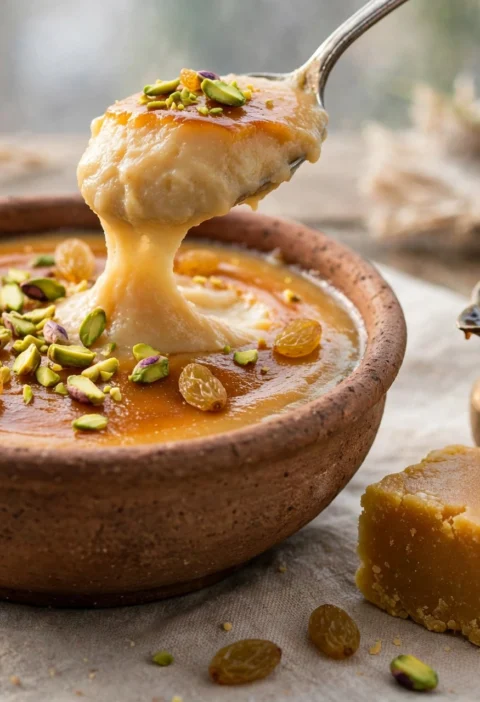
Transfer to a warm serving platter or bowl, smooth the top, and scatter over the toasted almonds, pistachios, walnuts, and chironji in a generous layer. Rest 10 minutes so it sets slightly — it should hold a spoon’s shape but yield softly. Serve this khas khas ka halwa recipe warm, in small portions; it is dense, rich winter food, and a little is a lot. Leftovers, if the family allows any, reheat beautifully.
Serving Suggestions
This khas khas ka halwa recipe is December-through-February food — the dessert you make when the fog sits on Lahore till noon and everyone needs warming from the inside. Serve it warm after a heavy winter dinner, in small bowls, with nothing alongside; it is complete as it is. Traditionalists eat it for breakfast on the coldest mornings, and having done it once, I understand: it is the most effective argument against winter I know. A glass of hot milk alongside is the only accompaniment it has ever needed.
It belongs to the winter-halwa shelf on this site. My gajar ka halwa is its famous sibling — same slow ghee bhunai, same khoya finish, but built on sweet winter carrots instead of poppy seeds, and the one most households make first. And my besan ladoo shares the roasted soul: gram flour browned in ghee until nutty, the same patience, the same winter logic. Make the trio across a cold month and your kitchen will smell like every dadi’s kitchen that ever mattered.
Storage and Reheating
This khas khas ka halwa recipe keeps exceptionally well — 7 to 10 days refrigerated in an airtight container, thanks to the ghee. It firms up cold into a dense block; slice off what you need and warm it gently in a pan with a splash of milk, stirring until it softens and shines. The microwave works in short bursts, but the pan restores the gloss better. It freezes for up to 2 months: portion, wrap tightly, thaw overnight in the fridge. The nuts on top soften after freezing, so keep a fresh handful toasted to scatter over reheated portions — a small effort that makes it taste freshly made.
Frequently Asked Questions
My halwa tastes bitter. What went wrong?
One of three things: the seeds were not soaked long enough, the paste was not ground fine, or the ghee went in before the milk had cooked the rawness out. Bitterness in this khas khas ka halwa recipe is always a prep problem, never an ingredient problem. For the current batch, a little extra sugar and khoya stirred through will mask it; for the next, soak the full twelve hours, grind to true silk, and give the milk stage its full fifteen minutes.
Can I use a regular blender instead of a wet grinder?
Yes, with patience. Soak the seeds the full overnight, grind in small batches with enough milk to keep things moving, and stop to scrape down the sides often. A high-powered blender does the job in a few minutes per batch; a basic one needs more batches and more scraping. What does not work is grinding the seeds dry — dry grinding makes heat, heat makes bitterness, and no amount of milk afterward fully fixes a bitter khas khas ka halwa recipe base.
Is it safe to eat poppy seeds in this quantity?
The culinary poppy seeds sold for cooking are a different matter from anything else — they are a standard food ingredient across South Asia, the Middle East, and Eastern Europe, eaten in exactly these quantities for centuries. Rinse and soak them well, which is what this khas khas ka halwa recipe does anyway, and cook them thoroughly. If you are subject to drug testing for work or sport, though, be aware that poppy seeds can occasionally trigger false positives — worth knowing, not worth worrying about at the dinner table.
Can I make it without khoya?
Yes — the halwa stands on its own, dense and nutty, and plenty of households skip the khoya entirely. Without it, add an extra 2 tablespoons of ghee during the bhunai and a splash more milk in step two to keep the texture from eating too dry. The khoya’s job in this khas khas ka halwa recipe is softness and milky depth; milk powder (1/3 cup whisked into the milk in step two) is the closest substitute if khoya is unavailable.
Recipe Summary
- Prep time: 15 minutes (+ overnight soaking)
- Cook time: 55 minutes
- Total time: About 1 hour 10 minutes (+ soaking)
- Servings: 8-10
- Cuisine: Pakistani
- Course: Dessert